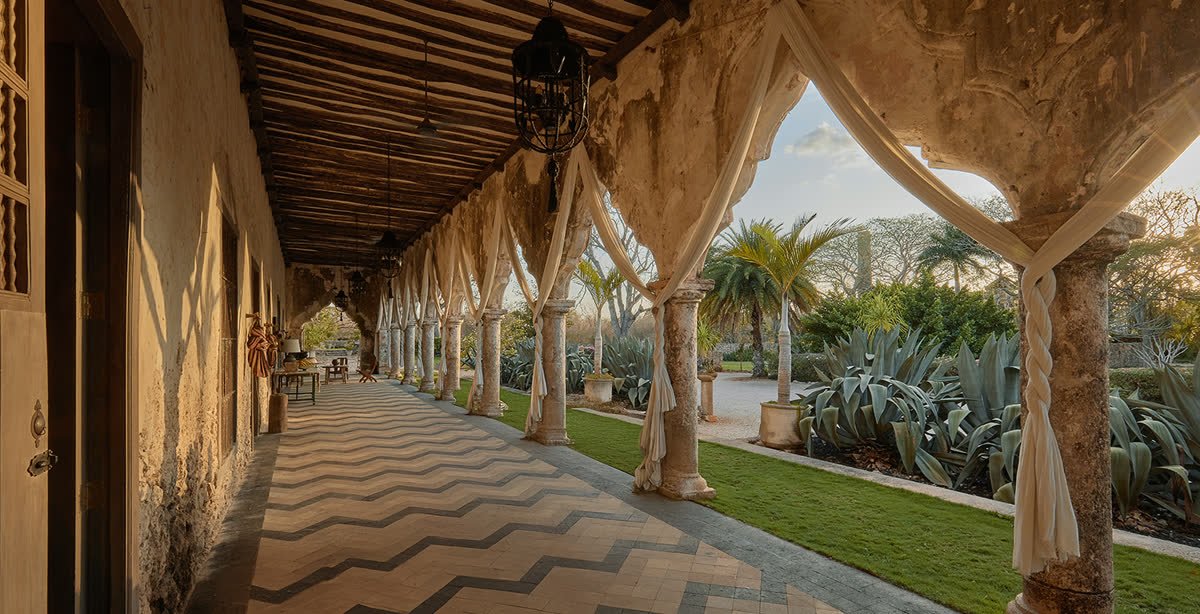
The walls were standing, but only barely. When designer Laura Kirar and her partner Richard Frazier first walked the grounds of a ruined henequen estate outside Merida in 2008, what they found was not a building: it was a conversation across centuries. Stone arches blackened by time. Volcanic rock floors still bearing the ghost of their original herringbone pattern. A reflecting pool choked with growth. And underneath everything, the buried foundations of a Puuc-era Maya temple that had been there long before the Spanish ever arrived in Yucatan.
What they did next, and the decade it took to do it, is the story of Hacienda Subin. If you are already drawn to what this place has become, reach us directly on WhatsApp and we will tell you everything. Otherwise, read on.
- Hacienda Subin dates to the 1680s: a genuine 17th-century henequen estate with over 340 years of layered history.
- Internationally acclaimed designer Laura Kirar (15 global design licenses, featured in Architectural Digest and The New York Times) personally oversaw a decade-long restoration beginning in 2008.
- Signature spaces include 11 original Moorish stone arches, preserved volcanic rock herringbone floors, the Morocco Room, and a cenote-style pool widely called the most photographed in Yucatan.
- Available as a 6-suite boutique stay (up to 12 guests) and as a full private buyout venue for celebrations of up to approximately 250 guests.
- Press coverage: Veranda, The New York Times, Architectural Digest, Elle Decor, Yucatan Magazine.
A Property With More Than One History
Hacienda Subin traces its documented origins to the 1680s, built as a ranching estate on the Yucatan peninsula during the height of Spanish colonial rule. Over the following two centuries it evolved, as virtually every Yucatecan hacienda did, into a working henequen estate.
Subin was one of those estates. Its history is embedded in the stone itself: in the tall archways that framed processing yards, in the machine house that still stands on the grounds, in the proportions of the main building designed to accommodate both family life and industrial scale.
When synthetic sisal arrived in the mid-20th century and destroyed the natural fiber market almost overnight, the haciendas were abandoned. Many collapsed entirely. Hacienda Subin sat in a long, patient silence until Kirar and Frazier arrived.
| Era | Architectural Layer | Key Feature |
|---|---|---|
| 17th Century (1680s) | Original colonial core | Volcanic rock herringbone floors, ranching foundations |
| Colonial era (18th c.) | Moorish-influenced front facade | 11 stone arches, henequen processing yards |
| 19th Century | French neoclassical rear wing | European stylistic influence added during henequen boom |
| 2008 to present | Laura Kirar restoration | Floor preservation, Morocco Room, cenote pool, Maya obelisk |
For more context on Yucatan's hacienda heritage, read our complete guide to haciendas in Yucatan.
Laura Kirar: The Designer Who Chose Yucatan
To understand what Hacienda Subin became, you first need to understand who Laura Kirar is. This is not a renovation project that was delegated to a contractor and managed remotely. Kirar moved to Merida. The hacienda became her home.
Kirar trained at the School of the Art Institute of Chicago (BFA, 1993, Sculpture and Interior Architecture), founded her design studio in New York City in 1999, and built one of the most quietly influential design careers in American interiors. Fifteen international licensing agreements, with Baker Furniture, McGuire Furniture, Ann Sacks, Arteriors Home, Carnegie Fabrics, Barlow Tyrie, and others, placed her work in hotels, residences, and hospitality projects across the globe.
"Spaces that communicate across time and cultures, with an eye towards maintaining the integrity of the original architecture." - Laura Kirar
A limited-edition table called Trenzita, incorporating henequen fiber braided with leather and finished in tortoiseshell lacquer, entered the permanent collection of the LongHouse Museum. That detail matters more than it might seem. The fiber she worked with as an artist is the same fiber that made Hacienda Subin. The designer and the property were already in conversation before she ever saw the place.
Her work has been featured in Architectural Digest, Veranda, The New York Times, Elle Decor, House Beautiful, Vogue Living, and Wallpaper*, among others. She has exhibited at Salon Art + Design at Park Avenue Armory (2018, 2019, 2021, 2023) and Design Miami (December 2023). Her furniture and objects are handled by Maison Gerard in New York.
She is, by any measure, a designer of international standing. And she spent a decade bringing that standard to a ruined hacienda in the Yucatan countryside.
Inspired by the design story? Come experience it in person at Hacienda Subin.
Ask About a Stay on WhatsAppThe Restoration: One Decade, Layer by Layer
Kirar's philosophy, carried through every decision at Hacienda Subin, was about maintaining the integrity of the original architecture while letting it speak to the present. That translated into concrete, painstaking choices across the entire property.
The Floors
The original volcanic rock floors, laid in a herringbone pattern common to colonial construction in the region, were uncovered, cleaned, and preserved. They are still there. When you walk through the main rooms, you are walking on the same stone that was laid in the 17th century. The weight of that is not metaphorical.
The Arches
The 11 Moorish stone arches that define the front facade were not reconstructed: they were maintained. Their Moorish character reflects the layered stylistic history of the building. A 17th-century core. A Moorish-influenced front facade. A neoclassical French rear wing added in the 19th century. Three architectural languages, one property, unified by Kirar's hand.
The Morocco Room
One of the most distinctive spaces in the house, cited specifically by Yucatan Magazine, is the Morocco Room. Kirar drew on a riad she knew in Fez, Morocco, and recreated its spirit using locally sourced tiles made by Yucatecan artisans. The wall murals feature dragonflies, red and blue, observed on the property during the restoration, painted in a style that echoes both local naturalism and decorative tradition.
The Pool
The cenote-style pool at Hacienda Subin is stone-lined, surrounded by the property's native gardens, and framed by the restored arches. It has been widely described as the most photographed pool in Yucatan (Yucatan Magazine, February 2026). It is naturalistic by design: it does not look like a luxury hotel pool. It looks like water that has always been here, waiting.
The Maya Obelisk
In the property's reflecting pool, Kirar placed a Maya obelisk. The pavilion at Hacienda Subin sits on the site of a Puuc-era Maya temple. The obelisk does not explain this history: it points toward it. Guests who notice it and ask will find themselves in one of the more interesting conversations they will have on any trip to Yucatan.
Planning a private celebration in a setting with real history? Let's talk about your event at Hacienda Subin.
Request an Event Quote on WhatsAppWhat a Decade of Design Education Brings to a Ruin
There is a version of hacienda renovation that is purely cosmetic: a fresh coat of paint, a plunge pool, some colonial furniture from a market in Merida. That version of "restored hacienda" is common in Yucatan. It produces pleasant hotels.
Hacienda Subin is something different, and the difference is legible if you know what to look for.
The decision to preserve the volcanic rock floors rather than replace them was not sentimental: it was architectural. The integration of Moroccan tilework made by local Yucatecan artisans was not decorative whimsy: it was an argument about how cultures travel and transform. The cenote-style pool was not an amenity: it was a design statement about belonging to the landscape rather than imposing on it.
Hacienda Subin Today: Stay or Celebrate
The property that emerged from Kirar's decade-long restoration is available in two forms. The decision comes down to the experience you are looking for.
| Aspect | Boutique Stay | Private Event Buyout |
|---|---|---|
| Capacity | Up to 12 guests (6 suites) | Up to approximately 250 guests |
| Access | Exclusive use of the property | Full estate buyout, no shared access |
| Setting highlights | 6 boutique ensuite suites, pool, gardens | Pavilion, reflecting pool, machine house, full grounds |
| Best for | Retreats, family getaways, honeymoons | Weddings, corporate retreats, quinceañeras |
| Distance from Merida | Approx. 40 minutes | Approx. 40 minutes |
As a boutique stay: six ensuite suites accommodate up to 12 guests in an intimate, privately held property. There are no strangers in the common areas, no hotel lobby crowd, no resort programming. There is a pool, a garden, century-old stone, and the kind of quiet that only a property removed from the world can offer.
As a private venue: Hacienda Subin is available as a complete buyout for weddings, corporate retreats, creative residencies, quinceañeras, and other milestone celebrations. The estate's grounds, including the classical pavilion, reflecting pool, native gardens, machine house, and the main hacienda building, offer a setting that cannot be replicated in any hotel ballroom, anywhere. When you host your event here, the property is entirely yours.
For more on planning a hacienda wedding in Yucatan, see our complete hacienda wedding guide. For the boutique stay experience, see our boutique hacienda stay near Merida. Or explore our private event venue guide to understand what a full buyout involves.
The Long View: Why This Story Matters to Travelers
There is a version of luxury travel that is about accumulation: more amenities, more service staff, more square footage per room. And then there is a version that is about encounter, with a place, with history, with the choices someone made to bring something back from ruin.
Hacienda Subin is the second kind of place.
When you stay in one of its six suites, you are sleeping in rooms that a world-class designer considered for years before touching. When you host your event under the stone arches of the main pavilion, you are gathering in a space that carries three centuries of human use. When you swim in the pool that Yucatan Magazine has called the most photographed in the state, you are in something designed to feel like the land itself. Not imposed on it.
"That is what a decade of careful, informed, artistically serious restoration produces. And it is, in its way, as rare as the hacienda itself."
Learn more about Hacienda Subin and the people who brought it back to life.
Frequently Asked Questions
Who designed Hacienda Subin?
Hacienda Subin was restored and designed by Laura Kirar, an internationally acclaimed American interior designer (BFA, School of the Art Institute of Chicago, 1993). She holds 15 international design licenses with firms including Baker Furniture, McGuire Furniture, and Ann Sacks, and her work appears in the permanent collection of the LongHouse Museum. She and Richard Frazier purchased the ruined 1680s estate in 2008 and spent approximately a decade on its restoration. The property has been featured in Architectural Digest, Veranda, The New York Times, and Elle Decor. Sources: laurakirar.com/studio, Yucatan Magazine.
What is the Morocco Room at Hacienda Subin?
The Morocco Room is one of the most distinctive interiors at Hacienda Subin. Designed by Laura Kirar, it draws on Moroccan riad architecture, specifically a riad she knew in Fez. The room features handmade tilework crafted by local Yucatecan artisans and murals of red and blue dragonflies observed on the property during the restoration. It exemplifies Kirar's design philosophy: holding multiple cultural traditions in a single, coherent space without flattening any of them. Source: Yucatan Magazine.
When was Hacienda Subin built?
Hacienda Subin was founded in the 1680s, making it a 17th-century property with over 340 years of history. The main structure reflects three periods: a 17th-century colonial core, a Moorish-influenced front facade, and a 19th-century French neoclassical rear wing. Restoration by designer Laura Kirar began in 2008 and took approximately a decade to complete. Source: Yucatan Magazine.
What is the most photographed pool in Yucatan?
The cenote-style pool at Hacienda Subin has been widely described as the most photographed pool in Yucatan. Designed by Laura Kirar to echo the naturalistic quality of the region's cenotes, it is stone-lined, surrounded by native gardens, and framed by the estate's restored Moorish arches. The pool is available to overnight guests and to groups booking the property for private events. Contact Hacienda Subin via WhatsApp at +52 999 279 1676 to inquire about availability.
What does henequen hacienda mean in Yucatan?
A henequen hacienda is an estate that participated in Yucatan's henequen (sisal) fiber industry, which dominated the regional economy from roughly the 1870s to the mid-20th century. Henequen fiber, extracted from the native agave plant, was used to produce rope and twine for global agriculture and shipping. Hacienda Subin, founded in the 1680s, was one of these estates. When synthetic alternatives ended the natural fiber trade, most henequen haciendas were abandoned. Subin was restored by designer Laura Kirar beginning in 2008.
Ready to Experience Hacienda Subin?
Every inquiry starts with a conversation. Whether you are drawn to a private stay in Yucatan's most intimately designed hacienda, or planning a celebration that deserves a setting with real history, we would love to hear from you.